

How Meditation Changes the Brain


Meditation, a practice deeply rooted in ancient traditions, has transcended time and culture to become a cornerstone of wellness in the modern world. Originating over thousands of years ago, meditation’s earliest records appear in the Vedas of ancient India and are also intertwined with the spiritual practices of Buddhism and Taoism. Initially, it was a spiritual endeavor aimed at transcending the physical state to reach a higher level of awareness and inner peace.
Over the centuries, meditation evolved into various forms and techniques, spreading across continents and cultures. Today, it encompasses a wide range of practices, from mindfulness to transcendental meditation, each with its unique approach but sharing a common core: the cultivation of a heightened, focused state of awareness and a sense of inner calm.

The Intersection of Meditation and Neuroscience
This ancient practice, once solely the domain of spiritual seekers, now stands at the forefront of modern scientific research. We aim to unravel the mysteries of how meditation not only transforms our minds on a subjective, experiential level but also brings about tangible, measurable changes in the brain itself.
From altering brain wave patterns to enhancing cognitive functions and improving mental health, the impact of meditation on the brain is profound and multi-faceted. By weaving together scientific findings, expert insights, and real-life implications, this post aims to shed light on how regular meditation practice can lead to enduring changes in our brain structure and function, ultimately enriching our lives in myriad ways.
The Science of Meditation
Understanding Brain Plasticity
At the heart of understanding how meditation impacts the brain is the concept of neuroplasticity. Neuroplasticity refers to the brain’s remarkable ability to reorganize itself by forming new neural connections throughout life. This adaptability not only aids in learning new skills but also plays a crucial role in recovery from brain injuries.
Meditation’s link to neuroplasticity is a topic of increasing interest in neuroscience. Regular meditation practice is thought to enhance this inherent plasticity of the brain. It involves training the mind to focus and redirect thoughts, which over time, can lead to significant changes in brain structure and function. These changes are not just psychological but are physically observable. For instance, areas involved in attention, self-awareness, and emotional regulation can show enhanced connectivity and density after consistent meditation practice.
Neurological Studies on Meditation
Several key studies have shed light on the neurological impacts of meditation:
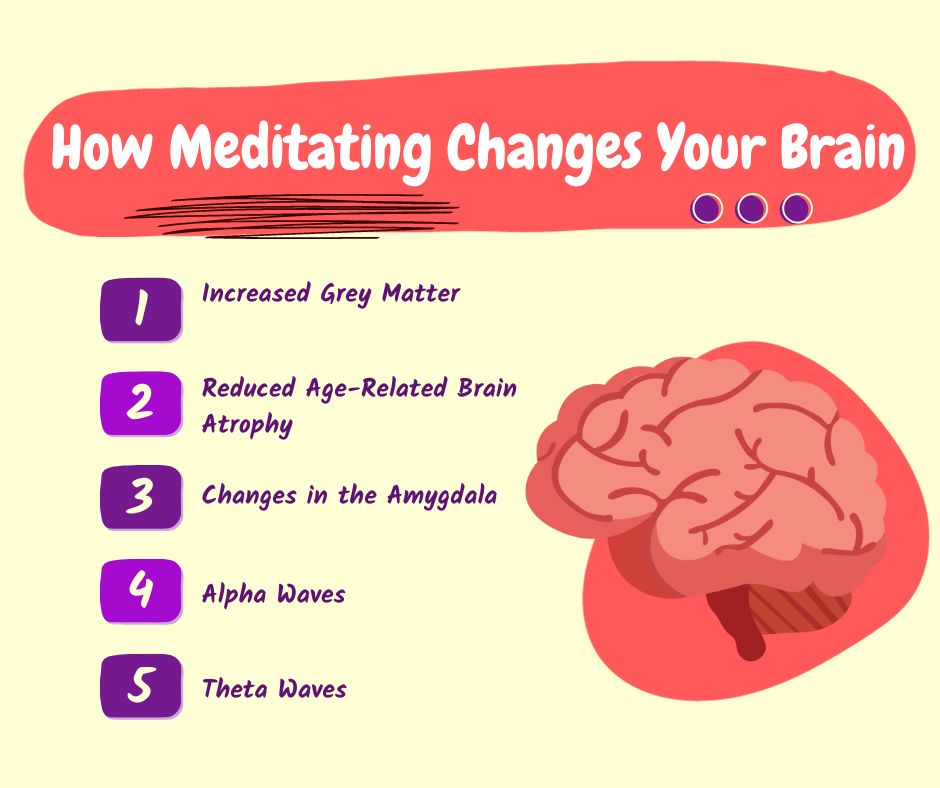
- Increased Grey Matter: A landmark study published in ‘Psychiatry Research: Neuroimaging’ showed that participants who practiced mindfulness meditation for about 30 minutes a day for eight weeks had increased grey matter density in the hippocampus, known for its role in learning and memory, and in structures associated with self-awareness, compassion, and introspection.
- Reduced Age-Related Brain Atrophy: Another study, featured in the journal ‘Frontiers in Psychology’, found that long-term meditators had better-preserved brains as they aged, with more grey matter throughout the brain compared to non-meditators. This suggests that meditation could be beneficial in mitigating age-related cognitive decline.
- Changes in the Amygdala: Research published in ‘Social Cognitive and Affective Neuroscience’ reported that after an eight-week mindfulness-based stress reduction course, changes were observed in the amygdala, the brain region connected to emotion and stress, correlating with reduced stress levels in participants.
Physiological Changes in the Brain
Brain Wave Alterations
During meditation, one of the most significant physiological changes occurs in the brain’s electrical activity, or brain waves. Typically, the brain exhibits various wave patterns, like alpha, beta, theta, and delta waves, each associated with different states of consciousness.
- Alpha Waves: Common in relaxed states and light meditation, alpha waves are associated with reduced stress, enhanced creativity, and an improved sense of calm.
- Theta Waves: These waves are more prominent in deep meditation and are linked to profound relaxation, heightened creativity, and increased introspection.
Studies have shown that experienced meditators can intentionally induce these states, suggesting a level of control over their brain’s activity that can be developed through regular practice.
Grey Matter Density
Meditation has also been shown to impact the physical structure of the brain, particularly in the density of grey matter. Grey matter contains most of the brain’s neuronal cell bodies and is crucial for processing information in the brain.
Increased Density: Regions such as the hippocampus, known for memory and learning, and areas associated with self-awareness and compassion, have been found to have increased grey matter density in individuals who practice meditation regularly. This increase suggests that meditation can enhance cognitive functions and emotional processing.
Psychological and Cognitive Benefits
Stress Reduction and Emotional Well-being
Meditation is widely recognized for its ability to reduce stress and enhance emotional well-being. Practices like mindfulness meditation encourage individuals to focus on the present moment, which can lead to a significant reduction in anxiety and stress. Studies have found that regular meditation can decrease the production of stress hormones like cortisol, leading to a calmer and more balanced emotional state.
Improvement in Memory and Attention
Cognitive benefits of meditation are well-documented, with improvements noted in memory, attention, and even the processing speed of the brain. For instance, a study published in the journal Psychological Science found that just a few weeks of meditation training improved participants’ focus and memory for the details of their tasks.
Meditation and Mental Health
Impact on Anxiety and Depression
Meditation has been found to be a powerful tool in managing symptoms of anxiety and depression. It encourages a state of relaxation and mindfulness, which can disrupt the cycle of negative thoughts often associated with these conditions. A study in the journal JAMA Internal Medicine reported that mindfulness meditation programs had moderate evidence in reducing anxiety symptoms.
Enhancing Mindfulness and Self-Awareness
Meditation also plays a pivotal role in enhancing mindfulness and self-awareness. It teaches the practitioner to observe their thoughts and feelings without judgment, leading to a deeper understanding of oneself and a more mindful approach to life.
Practical Tips for Incorporating Meditation
Starting a Meditation Practice
- Find a Quiet Space: Identify a serene location free from interruptions. This could be a designated corner in your home, a garden, or any place where you feel at peace.
- Set a Regular Time: Establish a consistent schedule for your meditation. Whether it’s early morning or just before bed, choose a time when you are least likely to be disturbed.
- Start Small: Initially, aim for short sessions, like 5-10 minutes. As you become more comfortable, gradually extend your meditation time.
- Choose a Comfortable Position: Ensure you are comfortable but alert. You can sit on a chair with your feet flat on the ground or cross-legged on a cushion on the floor. Keep your back straight but not tense.
Overcoming Common Challenges
- Dealing with Distractions: It’s natural for the mind to wander. When you notice distractions, acknowledge them without self-criticism and gently redirect your focus to your breath or chosen focal point.
- Building Consistency: Regular practice is key. Set reminders or alarms as prompts. Consider joining a meditation group or finding a meditation buddy for added motivation. Remember, consistency is more important than duration – it’s better to meditate for a few minutes daily than for a longer time sporadically.
These tips are designed to help beginners start a meditation practice and overcome common challenges, with an emphasis on practicality and mindfulness.
The Transformative Power of Meditation
As we have explored, meditation is not just a spiritual or relaxation practice; it’s a powerful tool for brain health and psychological well-being. The scientific studies we discussed reveal a fascinating transformation within the brain – from increased grey matter density to altered brain wave patterns, highlighting meditation’s profound impact on our neural architecture and function.
What’s particularly exciting is how these findings are reshaping our understanding of the brain’s potential. Neuroplasticity, once a groundbreaking concept, is now seen as a gateway to personal development and mental health, with meditation serving as a key to unlock this potential. The future of neuroscience looks promising, as it continues to merge with ancient practices to uncover new pathways for cognitive and emotional enhancement.
In this era of rapid scientific advancement, meditation stands as a testament to the synergy of age-old wisdom and modern science. It offers a path not just for personal growth but also for scientific exploration, opening doors to novel approaches in mental health treatment and cognitive enhancement. As we continue to delve deeper into the brain’s mysteries, meditation could very well be at the forefront, guiding us towards a deeper understanding of our own minds and the untapped potentials within.

Further Reading
- Increased Grey Matter: This study, titled “Eight weeks to a better brain,” was published in the Jan. 30 issue of Psychiatry Research: Neuroimaging. It was conducted by a Harvard-affiliated team at Massachusetts General Hospital and is the first to document meditation-produced changes over time in the brain’s grey matter. For more details, you can visit:
- Reduced Age-Related Brain Atrophy: The study “Forever Young(er): potential age-defying effects of long-term meditation on grey matter atrophy” was published in Frontiers in Psychology. It explores how long-term meditation might mitigate age-related cognitive decline and preserve grey matter in the brain. For more information, you can refer to:
- Changes in the Amygdala: The study on changes in the amygdala due to mindfulness-based stress reduction was published in Social Cognitive and Affective Neuroscience. It examines how an eight-week mindfulness-based stress reduction course can lead to changes in the amygdala, correlating with reduced stress levels. The study can be found at:
These studies provide a solid scientific foundation for understanding how meditation can bring about structural and functional changes in the brain.